Featured

A Second Existence – Epilogue  to ‘The Day That Wouldn’t Turn’

All stories are rooted in reality.

This story emerges from one of those early memories that lodge themselves in the mind like a splinter—small, nearly forgotten, yet somehow never fully dissolving. I was about seven years old, in Primary Two in Hong Kong, 1967. Our English teacher was Miss Lee, a young woman whose exact age I couldn’t gauge through a child’s eyes, where all adults existed in that vague territory of “grown-up.” Looking back now, she was likely in her twenties—barely begun.

One day, she simply wasn’t there anymore. The classroom door opened to a substitute, and Miss Lee’s absence stretched from days into permanence. Then came the whisper that travelled through our school in that mysterious way news reaches children: she had taken her own life. I cannot recall now who told us or how we came to know. The official story was sparse: young teacher, tragic decision, life cut short. Details, if any, have worn away like text on old paper.  But  sparse stories haunt  precisely where they omit. 

It was my first  encounter with mortality though to a seven- year old, death was abstract and incomprehensible —something that happened elsewhere, to others. Miss Lee hadn’t been close enough to trigger immediate grief in a child’s heart. She was simply our teacher, a figure at the blackboard, a voice reading stories. Yet her absence left something behind, a kind of shadow that has never quite lifted.

For many years, I carried the convenient explanation: a young woman who took her own life at her prime must have died for love. It was the story that made immediate sense, the narrative that required no further questions. When tragedy strikes someone so impossibly young, we tend to reach for the familiar plot—the failed romance, the broken heart, the love that destroyed rather than saved. I viewed her story from this assumption, because the idea that dying for a love that failed, however banal, offered a framework that made the incomprehensible seem comprehensible.

But as years accumulated and I grew more nuanced in my understanding of the complexity of human condition, this neat explanation began to feel like another form of silencing. Life resists singular explanations. A person is never just one story, one disappointment, one unbearable weight. She was a twenty something lady — old enough to have accumulated layers of frustration, aspiration, suffocation and longing that had nothing to do with just romantic love. Perhaps she was crushed  by the weight of others’ expectations, by a future that seemed to be a corridor with no doors. Perhaps it was the specific exhaustion of being brilliant with nowhere to apply that brilliance, or being seen only as what she could never fully be.

The truth is, I’ll never know the precise calculus of her decision. But in growing older myself, I’ve learned that reducing her to a love story was my child-mind’s way of organizing chaos—and then my adult mind’s lazy acceptance of that childhood framework. The real gift fiction offers isn’t the ability to solve her mystery with a convenient plot, but to acknowledge the mystery’s true dimensions: that a life can be unbearable in ways that have nothing to do with romance, that despair can accumulate from a thousand small refusals rather than one dramatic rejection, that sometimes the story we tell about someone’s death says more about our need for comprehension than about their actual experience.

Over the decades, this memory –  if memory is even the right word for something that time has dissolved into imagination –  has settled into the sediment of my consciousness, mixing with other losses, other moments when life revealed its fragility. The specifics of Miss Lee herself—her face, her voice, the particular way she held chalk or turned pages—have faded beyond recovery. What remains is not her portrait but something more elemental: an early understanding that lives can simply stop, that young women with their whole futures ahead can choose to step out of time entirely.

I find myself calculating sometimes: she would be in her eighties now had she lived. All those unlived decades accumulate into a kind of shadow existence, a parallel life that never was. In Hong Kong’s relentless forward motion, her story was quickly paved over, but something in me refused to let her disappear completely.

I’ve borrowed the shape of my seven-year-old bewilderment and wrapped it in fiction, creating a ghost who waits in that flat, suspended between departure and arrival. Because that’s what haunts me still—not just her death, but all those interrupted possibilities, the thesis never defended, the pupils never taught, the life never fully lived.

Fiction cannot resurrect the dead, but it can offer them what history denied: complexity, interiority, voice. In imagining Sylvia’s ghost, I’ve given Miss Lee a space to exist beyond the verdict of her final action—not to excuse or explain, but to insist on her fullness as a person who was more than her ending.

She can therefore be given  a second life in the reconstructed reality of a story. And perhaps that’s the power of fiction: to create parallel realities where different laws govern what’s possible. You might argue that,  as with Bryony’ s alternate ending  in Atonement,  these reconstructed lives and possibilities are self-delusion—comfortable lies we tell ourselves about permanence and loss. But here’s what unsettles me: I’m not sure our own sense of existence is any more “real” than the reality we create for the dead in stories. We live inside narratives too—the stories we tell  ourselves about who we are, why we matter, what our lives mean. Our consciousness is already a kind of fiction-making machine, constantly constructing coherent narratives from the chaos of experience. We’re all , in a sense, fictional characters under our own self-authored stories.

This story, then, is my attempt at what the living owe: to tell a story for someone who can no longer speak, to imagine her not as tragedy but as a complete consciousness, still waiting to be understood. In giving her fictional form, I haven’t changed what happened, but I’ve changed how she’s allowed to exist in memory—not as a cautionary tale or a tragic statistic, but as a woman who lived, who struggled, who mattered, and who deserves more than silence.

Featured

The Day That Wouldn’t Turn: A Short Story


The living owe it to those who no longer can speak to tell their story for them.
—Czesław Miłosz


I got off the bus into the early dark. That particular November dusk already filled with a cool sensation. A woman stood still  beneath the amber streetlight.  Leaves from the trees that lined the street dropped and brushed past her hair and  shoulders. They had clung  to their branches until with a quiet resolve, they finally let go –  drifting past her before resting on the ground softly, waiting for the wind to carry them somewhere. She looked at me as if we had agreed to meet and  I hadn’t remembered.


“Would you come with me?” she  beckoned  in a tone so soft that I could hardly hear it. 

As if under a spell, I heard myself say yes and followed her.  At the time, I didn’t know why there was  none of the usual calculations and hesitations that rise when a stranger asks too much too quickly.  I could hear  only my footsteps as  the leaves crackled under them. Perhaps I was too conscious of my own.


She led me farther from the bus stop, away from the constellation of  neon lights on Shaukiwan  Road.  We continued  until the city’s bluster  and din faded behind us.   Before I knew it, we were  walking past a row of dimly lit Hong Kong cafés, their neon signs flickering in the humid air. Through fogged windows, I glimpsed marble tables, red vinyl stools, and ceiling fans turning lazily above the haze of cigarette smoke. From an old radio came the ghostly strains of Cantonese opera—music from another time. The aura was eerily familiar.    It felt as though we had stepped into the Hong Kong of my childhood.

As we turned into a narrow alley,  an old worn building surfaced from the dark,   its concrete  the colour of weak tea;  balconies rusted, laundry lines hanging slack. I recognized the type immediately—a post-war tenement like the one I’d grown up in, the kind still sheltering families in some run-down areas today. But this one stood strangely isolated, a solitary block with no neighbours, as if the city had receded around it like a tide. She looked up at a single window that framed a faint yellow light.


“So… it’s your home?” I asked, needing something – anything – to fill the silence between us.

“I keep a place,” she said. “It keeps me.”

That’s where I … she paused before she uttered  ‘live’, looking up at that lit window.  In the immensity of the dark, there was no mistaking it; every other unit was a blind eye.

The entrance to the mansion smelled musty with a hint of rust. No bulb burned.  I felt my way up a wooden spiral.  The banister was worn  smooth with the polish of hands that, as I would later find out,  had long stopped coming home. I was about to turn my phone light on as I was ascending. But she stopped me.   Please don’t , her voice  slightly trembled . The staircase was too narrow  to  permit us to walk abreast. I followed her, with each  stair groaning under my weight.  I was curious though why hers were accepted with its stoical silence .


At the top, her hand hovered near the latch of an rusty iron gate.  It’s a bit nippy inside, she warned.


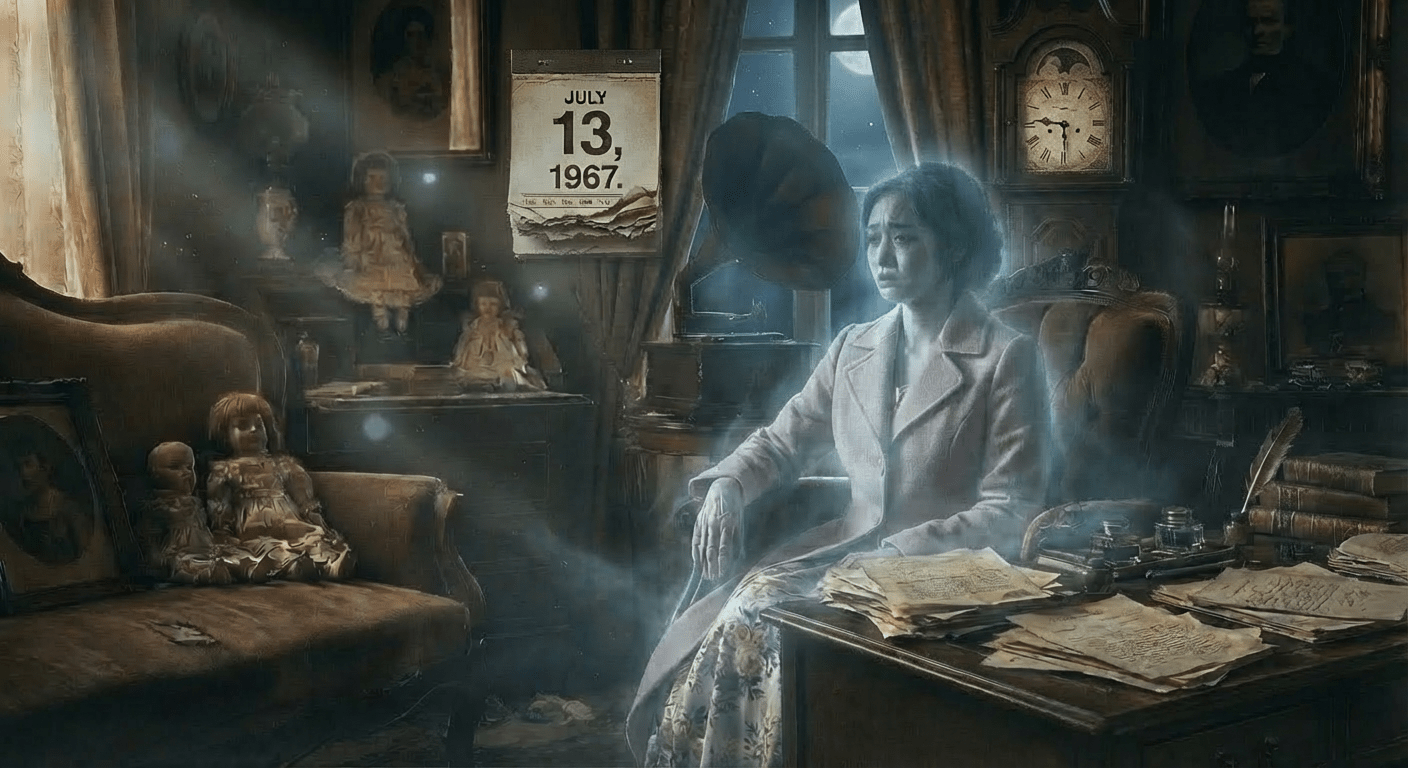
The door creaked open. A small dining room awaited inside, lit by a weak bulb  that struggled against the darkness. I could see her more clearly now. She looked in her early twenties—her complexion pale, her eyes touched with sorrow. She was so pale  she might have been formed from the weak light itself.   She was wearing  a pink coat over a floral, knee-length skirt, the kind of style my mother and her contemporaries would wear in her young days.  Most of the time, she gazed towards the window, as if searching for something far beyond it.
I wonder how the world outside is now, she mused. 
You may well step out and feel it yourself,  I was going to say.  But I held back, surmising that she looked so sickly  that she must have been too frail to go outside.  Yes, it’s a bit chilly outside. I said. I knew  I’d said something  irrelevant.  She  pressed herself against the window for sometime. She then left her face off the window. The window  did not leave any steam as if  she was holding her breath while she was looking. 


Your dress, I said, looking at the careful pleats and  the modest hem. It looks belonging to  another era.


Really? She glanced at the mirror as if noticing it for the first time in years.


No one dresses like that anymore, I said gently.
I suppose fashions change. How long has it been?  She smoothed the fabric with pale fingers.

She turned  her eyes to the wall above the table.
A photograph in a rosewood frame hangs on the wall. It captures a young woman in her early twenties. She stands in a park, framed by a profusion of flowers, her hands loosely folded as she smiles toward something beyond the camera’s view. Her image, in her pink dress and light windbreaker,  create a relief against  the surrounding azaleas, lending balance to the composition. The sunlight falls across her right cheek, forming a small, luminous highlight that draws attention to her calm, youthful face. Her unblemished complexion  and bright clear eyes exude a freshness that unmistakably only belongs to the very young.  Perhaps because there is a breeze stirring her hair, sending soft waves across her shoulders, she gently restrains with her hand  a few strands from drifting free. Her body leans lightly against the trunk of a nearby tree, giving the pose an easy, unforced grace. Her smile captures a quiet, fleeting moment of natural warmth.


I took this in the Botanical Garden in the autumn of 1966, she touched the photograph.  I sensed an uncanny moment as I looked between the image and the woman beside me. They were the same. Not similar,  not  resembling, but the same.  The same pink coat, the same angle of the shoulders, the same tilt to her chin—only much paler now, perhaps the years had slowly drained the colour from her while leaving everything else untouched. It was as though she’d stepped out of that silver halide a moment ago and spent decades trying to find her way back into the frame.

The room suddenly felt unmoored from reality. Where was I? More importantly—who was it that was sitting across from me? The girl from the photograph who never  ages past that distant  autumn of 1966, or something that had simply borrowed her shape and refused to let it change?


Are you afraid of me? Perhaps she had noticed that I was shivering. Yet the  profound sorrow in her face stirred something gentler in me, softening my fear before it could take hold.

No, not really. I composed myself.


As she moved towards the window, I took the moment to survey the place. It had the stillness of a held breath. Navy blue paint peeled from the walls in long strips, exposing patches of gray plaster underneath. On the dresser, an old wind-up clock sat silent, its key still protruding from the back, hands frozen at some forgotten hour. A lamp with a yellowed shade cast dim light over a small table which held its arrangement like a museum display —a teacup with dried residue forming rings inside, a pair of glasses folded over a newspaper, a bowl with three wrapped coconut sweets, all coated with a thin film of dust.


You want to…. tell me a story? I asked, trying to establish why she wanted me to come with her.


If I doubted anything about reality, it’s never that reality had deserted us. This WAS reality now: The flat. The woman. The clock. The table and its things.   Actually, everything within these walls. This was what was real—so why should I trouble myself with my own idea of it? I’d completely lost track of what that “reality” was supposed to be anyway. Whatever order of reality this was, it had become the only one that mattered. And I, through my deepening entanglement with this place, felt myself becoming part of the reality the flat contained—as if this was where I’d always been meant to be.


I was no longer afraid.


On the wall, a calendar showed  the 13th  of July 1967.
The calendar has held that date for as long as anyone remembers, she said. it hasn’t  been turned ever since .

I didn’t die here, she added.


Where then? I asked, confused.


Her eyes moved to the window. The sash was painted shut, sealed by decades of humidity and neglect. That window hasn’t opened since the 13th July . I walked to Sai Wan Ho Jetty on that day. There’s a small stretch of water there, away from the main harbour traffic. That’s where I went in. Her voice was matter-of-fact, as if describing a routine errand. But afterwards, I found myself back here. This was my home.  Her gaze drew mine  back to the calender.  Everything about me ended and began all in the same day.


A silence fell between us. My gaze drifted around the unchanged room and caught on something I hadn’t noticed before—a clothesline stretched from wall to wall. A single floral shirt hung there, arms spread slightly as if mid-gesture, the fabric holding the ghost of a shape. The print had faded but I could still make out small blue flowers against what was once white.

She followed my gaze. I wore that on my last day.

By this time, I already felt at ease with her and felt at home to ask more. She sat down at the table, running her fingers along its worn edge.

People say I died for love, she said. It makes the story simple. It fits neatly into their desire of hearing a tragic romance.  She looked at me. But it wasn’t just him. It was everything the waiting turned me into.


She told me about how she fell in love with a young man. He promised he would come back from his study overseas, —perhaps in one year, he said. At first the letters came thick and eager. Then they thinned, like a season fading. Then nothing. Hers went out into the void.

His name doesn’t matter anymore, she said. What happened to me was bigger than a name.

I had a life of my own to live. Her tone grew more certain as she continued.  I taught primary school to save money to go to a university abroad. I  had to tend to my aging mother and look after my little brother. I waited for my opportunity.  I waited for his return.  Over the years, that life turned out to be one of waiting, hoping and eventually disenchantment.    The waiting was just one thread woven through all the rest.


The things on the table chimed in with their testimony. A rejection letter from the University of London, —the paper yellowed at the edges but the words still sharp. Two tickets for West Side Story, the show date two months past, never used. A stack of pupils’ exercises she’d been marking, red pen still uncapped beside them. An unfinished lesson plan for teaching the alphabet, the letters A through M carefully illustrated; the rest left  forever waiting. Amidst all this lay a scrap of notepad paper on which was written in a steady and careful hand: prepare pills for mother.

Every day was full. She continued: But full of things that led nowhere. I was always preparing for a life that kept being postponed.

I spent my life waiting. At first, I knew what I was waiting for: His return, the day when I could have saved enough money for university, the results of applications. And then year after year, I lost focus. It all blurred into a dull sensation,  waiting with no specific goal.  It just became a dreary game of waiting,   yet I felt compelled  to wait. As for waiting for what, I was no longer sure. She looked away, her voice fading.
Instead of letters coming from him,  rumours found her.   Some said he had fallen ill. Some said he had stayed overseas, married there. Someone swore they saw him back in the city, thinner, changed, a quick shadow near the tram stop.

I waited for years, she murmured. When footsteps came down the corridor, my heart quickened. Could it be him? But the doorbell never rang with that particular visitor she had been expecting —a slim young man with hair parted to the right, who would say her name and pull her into his embrace.


She paused, then again: Waiting became the role everyone gave me. At first, I told myself stories— He’ll come back soon, I’d whisper to my reflection.  Just save a bit more money, then apply to university again. But my mother had other plans. You must wait until your brother grows up, she would say. A daughter’s duty is to family, not books. So I waited for my brother to finish school. Waited for enough savings. Waited for life to somehow rearrange itself into what I wanted it to be. Each year, another reason to postpone. Another obligation. And he—the one who never wrote, never returned— became just one more thing in a long list of things that would never come.


By the time I finally understood he wasn’t coming back, it didn’t matter anymore. The role had already been written for me. One word: Wait.  Then there was another voice inside me gathering momentum:  Sylvia, you can break it. Now,  I know what I should do. She said calmly, and I could hear in her voice that fatal moment of clarity—when the path forward had suddenly revealed itself.


I didn’t die for a man, she said firmly. I refused the life that made waiting my whole identity.


She told me about her childhood—growing up in a modest family  where her younger brother always came first, no matter what she achieved. Her father didn’t  particularly like working; responsibilities slid off him and onto everyone else. But she cherished small joys too: a stray cat that chose their doorstep, the triumph when her first loaf of bread rose properly in the oven. And that first Christmas ball at school when she was 16—she wore a blue floral dress and when a boy asked her to dance, she felt something shift inside her, some door opening onto a different possible life.
Those were the little stories, she said, the threads in the fabric. But they felt like sparks—bright for a breath, then gone into the dark.

She had been keeping diaries —years of them—and a bundle of the man’s letters. I threw them away. They all contained an agonising voice of a life that clamour for fulfillment yet being dragged by indefinite waiting.   When I decided to define my life on my own terms, I let them go. Each entry pinned me to a day I didn’t want to live in anymore. When I burned them , I felt a tremendous sense of letting go, symbolic if not actual.

I asked if that brief liberation might have prepared her for what was to come. 


Sort of,   she said softly. I still felt crushed by the gravity of the present. The diaries were the first refusal. Death was the only thing left that I could choose .

On  the 13th of  July, the feeling that had been humming for years gathered itself. Everything she had postponed stood around her at once, and all the doors she’d been promised were still shut. It was as if a black circle opened in the middle of the room, made from every “not yet” she had ever obeyed.

It wasn’t a rushed decision, she said. I stepped into it – she stressed the word –  refusing to keep orbiting a life that never let me begin.

I missed my chances, she whispered, and a tear rolled down her cheek. I was cut off in my prime. I lost the chance to find out what living feels like over a long stretch. Maybe even to learn what a love that lasts actually is.

Maybe, I said.  You might have suffered more by living. Or less.  But who knows?  We only guess what other lives  could have been for us.

She smiled. You’re saying there might have been lives I saved myself from without knowing?

I’m saying none of us gets the full accounting. Most lives are patchwork anyway, and whatever warmth we find comes from the stitching itself, from creating meaning for your present.


She was  silent again. But I had tried, she said.

She glanced at the calendar. And this? What do you call this?

A life with one day kept, I said. Not wasted— just a different way of becoming.  You spent everything you had to preserve that single moment, that exact point you ended your life.

She was quiet for a moment. I missed the chance to grow old. To watch those pupils become adults with their own pupils to mark. And to see if the city would change or if I would.


Perhaps by freezing yourself that day, it’s not so much the dramatic moments you would have missed as… that gentle erosion and shaping that comes from everyday life. Like an artist’s kneading, you know? Small things—hair going gray, hands that know their work, that favourite teacup that gets worn smooth where your thumb rests. The window where you’d watch the same trees turn green, then brown, year after year. Everything in between.


Yes. And more, she said. I missed the chance to forgive, she continued with the words coming harder now. To forgive him for not returning. To forgive myself for waiting. Maybe forgiveness only comes with time, and I didn’t give myself enough.

Do you regret it? I asked.

The question seemed to fill the room. She didn’t answer. The silence stretched until it became its own reply: some choices are beyond regret. They simply are what happened, the path the story took.

Why tell me all this? I asked.
I need someone to know I existed—that our love was real, even if it ended in shadow. That I once lived  with a throbbing heart.  Please write that I did not succumb to frustration. Write that I refused to live by the script life handed me. I didn’t accept the part.
She looked at me directly. Write that my story isn’t that of  Ophelia floating downstream with her flowers. I chose to leave—I just never got all the way gone.


Never got all the way gone? I echoed, not quite understanding.


I’m caught, she said, her voice steady but distant. Too far from life to return, not far enough gone to reach whatever comes after. Suspended in the space between my  memory and the next world’s threshold—like a door that won’t quite close. Her words made me think of the Haunted Mansion’s ballroom scene in Disneyland—spirits locked in an endless waltz, circling through dusty air and faded music. Like her, they were caught in a single moment stretched into forever, performing the same steps in the half-light between worlds.


People like to box me into a neat romance that failed—a pretty tragedy with a moral attached.  But I’m not a cautionary tale. I was a person.

So you’ll write my story? She looked at me, almost beggingly.

Her expectations weighed on me like a coat I hadn’t asked to wear but couldn’t refuse. This was no longer just about a young woman long forgotten by history. Her story had become something else to me now—a debt between the living and the dead, a responsibility I hadn’t sought but recognized. Perhaps it was the way she’d walked me through those collapsed decades, showing me how thin the membrane was between her 1967 and my present 2025. Or perhaps it was simpler: she had no one else to ask, and I was the only one who’d followed her up those stairs, the only one who’d sat in her unchanged apartment and conversed with her – though anyone reading this may think it mere  imagination.

And perhaps most importantly —though I can’t quite  explain it—I felt sure I’d met her when I was small. The memory wouldn’t come clear, only the conviction that somewhere in my childhood’s blurred landscape, she’d been there.  The obligation felt both ancient and immediate—the old contract between witness and testimony. She’d chosen me, or time had chosen me for her, to carry what remained of the 13th July , 1967, back into the world of the living.
How  then could I refuse the dead their only request?


Yes, I will. I promised.


Thank you. And those were her last words.


Whereupon she got paler almost to the point I started to be struggling to distinguish her from the weakening   amber light. Her form grew fainter, as if the telling itself were a key turning. The house listened once more, then let go.

Silence settled. In the mirror, only my own face looked back. Outside, the autumn wind stirred the leaves with nothing but its own voice.  When I looked back the flat, the lamp that had burned for fifty-eight years went dark.

I stepped out carrying her story. Only then did I understand why she had chosen me: I, too, had my waiting hours—for a love that had left, for a life that would not arrive. Her warning was simple: waiting is not a life.
By morning, the old building was gone. The site stood empty—truly empty—for the first time since 1967. Perhaps that was her peace: not in death, not in the long vigil, but in being seen at last—remembered without the myth, carried forward without the neat bow of a moral.

I thought of the small things she’d wanted: the harbour at dusk, the steady tide, the children growing, the gray that comes honestly. I promised, out loud to no one, to choose one unglamorous act of living each day and to call it by its name.


She was weightless in every physical sense—a woman made of memory and air. Yet she’d been pinned to this place since that calender date by something heavier than any living body: the need to be known, to be remembered, to have someone say : yes, you were here and listened to.
Somewhere – if there is a somewhere – she should now feel lighter for having been told.

And somewhere closer, the part of me that kept a chair for what never arrived got up, switched on a new light, and began to write. Through the writing, the gray man at the present, the woman who never ages past 1967, and that child in a classroom sixty years ago became part of the same story—though which one of us was telling it, I could no longer say.

Written on 25 December  2025

(Epilogue to follow in the next post)
Featured

Escaping the Illusion of Infinite Choices

Have you ever opened Netflix, spent 20 minutes scrolling, and then… just closed the app? Yeah. Same. At this point, I think I’ve spent more time choosing what to watch than actually watching anything.

It’s funny—we live in a world overflowing with choices.  The gamut of cereal.  Different kinds of milk (oat, almond, soy, cashew… I can’t keep up). An endless  list of job adverts. In my case, a hundred book titles   my friends swear you ‘must’  read, or a Google search would recommend you. You’d think all these options would make life better, right?

Well… maybe. But it ain’t always a yes.


There’s this idea in philosophy and psychology called “the paradox of choice”, which basically says: the more options we have, the more overwhelmed we feel. And honestly? That checks out. Just yesterday, I spent an embarrassing amount of time trying to choose a book from google search. Yes, just a book. Sounds like not that big deal. But I ended up spending the amount of search time that I would have used to do other more interesting things. But that’s what it was. 

Here’s what’s wild: having more options feels like freedom, but it can also feel like pressure. If you have only two choices and you pick the wrong one, you shrug it off. But with 200 choices? Suddenly you start thinking, “What if I missed the perfect one? What if I chose wrong? What if my soulmate book is sitting on page two of search results?”

And that’s where things get interesting. It’s not just about book choices. Choice shapes how we see ourselves. What we pick becomes part of our life, our identity —and that makes choosing feel bigger than it really is.

But let’s be honest: oftentimes, we don’t need the perfect option. We just need one that works. Still, something in us loves to agonize over tiny decisions as if we’re philosophers contemplating the meaning of life.

So I’m curious—what’s the last thing you overthought way too much? 
A pair of shoes? A restaurant? A phone avatar? (No judgment. I’ve changed my avatar three times this week.)

Here’s what helps me when I’m stuck in Decision Overload Land: 
• limit the number of options I’ll even look at 
• give myself a time limit (surprisingly effective!) 
• accept that “good enough” is… well, good enough  and jump right into it with a leap of faith.

Because maybe the goal isn’t to find the perfect choice. 
Maybe it’s just to enjoy the choice we make.
What do you think?

Are you a “decide in 5 seconds” person or a “compare every grain of rice” person? I’d genuinely love to know.


P.S. And honestly, in our age of endless information, this whole “paradox of choice” hits even harder. We’re constantly nudged into this myth of option meaning freedom —when half the time, it just means more stress. The good news? We do have agency. Sometimes the most powerful choice is simply refusing to get sucked into the endless scroll of possibilities.

Featured

Why Soft, Simple Writing Stays with Us

You don’t always need big ideas or sophisticated literary techniques to make an impact. Sometimes a softer approach—a simple story told without complexity or pretension—can reach people more deeply. Tuesdays with Morrie is a perfect example of that. It’s quiet, straightforward style doesn’t try to dazzle the reader. Instead, it invites you in gently, and before you realize it, the book has settled into your heart.

You know, one  reason the book pulls people in is it’s written almost like a real conversation you’re overhearing. When you read it, you don’t feel like you’re studying themes or analysing arguments—you feel like you’ve just pulled up a chair next to Mitch and Morrie. The dialogue is so warm and natural that it’s easy to slip into the rhythm of their talks. And because most of us have had moments like this with someone older or wiser, it instantly feels familiar. It makes you think about your own conversations, your own memories, your own questions about life. The book doesn’t push you away with big ideas; it invites you in, gently, as if saying, “Sit with us for a bit.” That’s a big part of why readers feel so involved, even though the story is simple ( there’s hardly any plot to speak of ) and  the language plain. The ideas don’t feel particularly profound or original. But that’s part of  what makes it  so accessible to readers.

Featured

Telescopic Lives: A 400‑Year‑Old Man Remembers

PROLOGUE

Recently, I read How to Stop Time by Matt Haig, a novel about a man who ages far more slowly than everyone around him. The story follows him across centuries, watching people he loves grow old and disappear while he continues on. Something about that premise stayed with me—the way memory stretches, blurs, and reshapes itself when a life lasts far longer than it should. It got me thinking: what would memory feel like if only one person lived to be 400 years old while everyone else lived normal lives? Since no one has ever lived long enough to tell us how their centuries-old memories feel –  just like no one has ever come back  from death to recount what it lies beyond –  the question became the seed for the thought experiment that follows.

In this piece, I explore, more decisively than Hamlet does  in his contemplation of the state after death, this thought experiment through the imagined monologue of such a man—one who remembers, forgets, and reflects on the long-distant past in ways the rest of us can only guess at.

MONOLOGUE

[Quietly, near a window overlooking a timeless landscape]

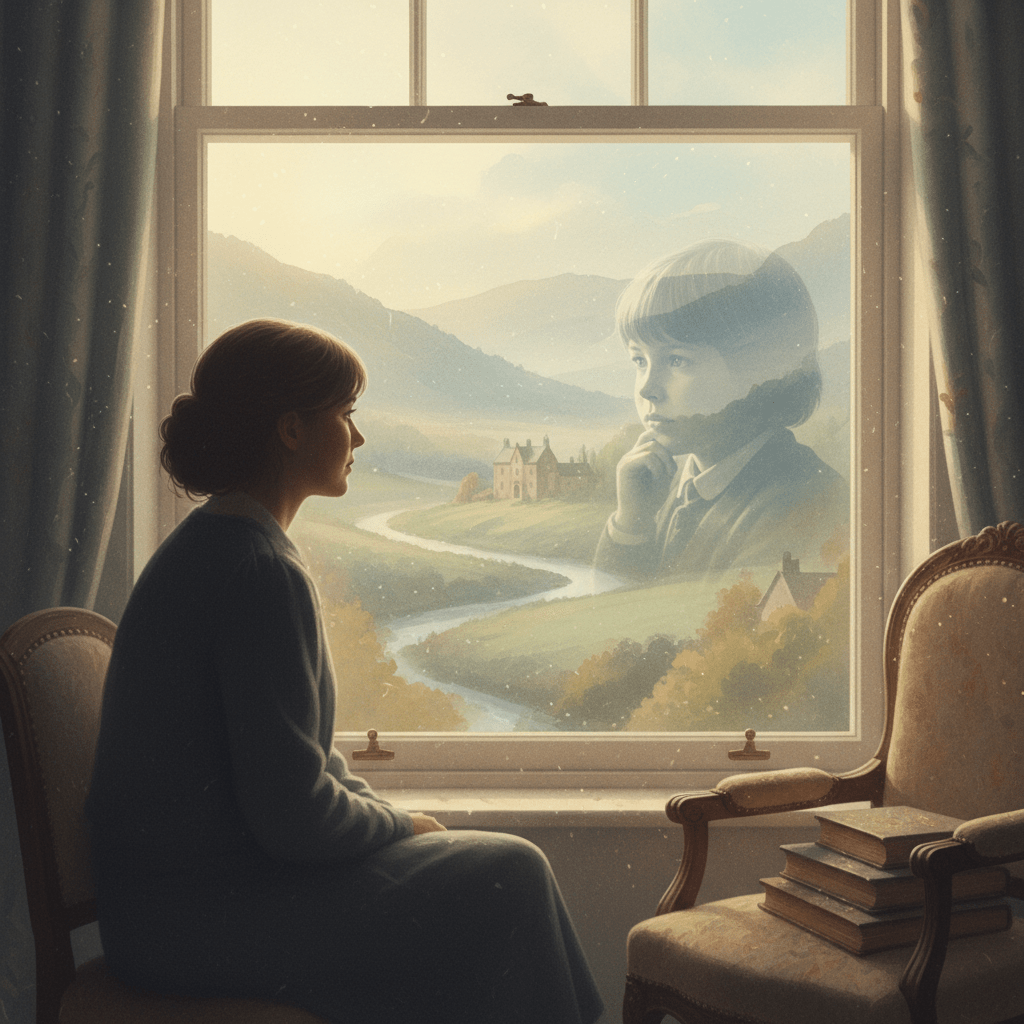
Four hundred years… and sometimes I still wake expecting to hear the voices of people who have been gone for centuries. Longevity, when it belongs only to you, is not a gift you hold—it’s a room you inhabit alone.

Everyone I once loved lived their natural span, just as people always have. They aged, they weakened, they died… and I kept going. At first I tried to hold every memory close, terrified that forgetting them would be another kind of death. But the centuries have their own logic. Memory thins, the edges blur, and what remains are mere impressions—warm, but drifting further away in the  universe of my mind.

How do I feel now? Strange, mostly. Not sorrowing the way I once did, but not untouched either. There is a quiet ache that never quite leaves. I walk through a world  of young faces, new families, new stories, while mine stretch back so far that even I struggle to recognize the person I used to be.

The people I lost… I remember them not as portraits but as atmospheres. My parents feel like the sensation of  being hugged, rather than two specific faces. Friends from early centuries linger in me only as a jingle of laughter, or just the faint  afterglow of being together – warm, cosy –  but not as clear images. My siblings, my niece … but wait.  Were they there in the first place? Were there truly people tied to me by blood?  Oh, yes, thanks to those persistent,  involuntary flashes of memory,  I recall their names, James and Lydia. But little else. After  so many lifetimes have passed since those early days, my remembrances  of them have dissolved into  abstractions. It’s only by simple logic that I’m sure I watched them grow old, and that I must  have been with them in their dying days and that I must have grieved. But that certainty only comes from reasoning. Simple logic gives me facts. It doesn’t  retain  the lingering rawness of emotions, the sharpness of images I might  have had if I’d lived a normal span, an old man in his eighties,  reminiscing about the past.  The love of my life—her memory has become a feeling more than a person… a warmth in the chest, a softness in the voice when I speak of certain years.

Sometimes, though, something jolts my numbness: a particular melody, a scent, a phrase someone speaks with the same rhythm as a friend long gone. In those déjà vu moments, memory briefly sharpens, and for a heartbeat I see them with startling clarity. It is beautiful—and it hurts. Because the moment I notice that clarity, it slips away again.

Do I feel lonely? Yes, in a way no one around me would understand. Not for company—I have that though  I know  I will again lose it —but for shared history. No one alive remembers the world I began in. No one remembers the people who made me who I am.  Their stories exist only in me, and even I carry them imperfectly now.

I’ve made peace  with all this.  And I also feel grateful. Grateful that they lived, grateful that I knew them, grateful that even centuries later, the essence of them still stirs within me. They are not gone—not entirely. They’ve faded into the foundation of the person I’ve become. And though details fail me; the influence does not.


But tonight? Tonight I miss the texture of them. The sound, the touch, the weight of a hand in mine. That… that never stops aching. Not sharply. Just… persistently. Like the tide, always there, always pulling something back out to sea. 

Four hundred years. You carry what you can. You let the rest become starlight. 

Featured

The Paradox of Creating From Dreams

While I might want to sketch a rough contour of my dreams upon waking up, and fill in the details later, there lies a paradox in that process of creation.

Dreams can be a powerful source of ideas, but they come with a strange limitation: we usually remember only pieces of them. The moment we wake up, parts start fading, no matter how hard we try to hold on. And yet, those fragments often spark something new—a thought, an image, a feeling that pushes us to create.

That’s the paradox. Any dream‑inspired creation depends as much on forgetting as it does on remembering. We can’t bring a full dream into waking life. We can only carry whatever survives the transition. By the time we write it down or turn it into a drawing or story, we’ve already lost parts of it. The act of creating from a dream is also the act of accepting that much of it is gone.

But this isn’t necessarily a problem. Forgetting can actually help us. When the exact details slip away, we’re free to interpret the fragments in our own way. We fill in the gaps with imagination, experience, or intuition. The result isn’t a perfect record of the dream; it’s something new that grew out of it.

So whenever we create something based on a dream, we’re really working with both memory and absence. What we remember gives us the starting point. What we forget opens space for creativity. In the end, the finished work becomes its own thing—shaped by the dream, but not bound to it.

No great artists or writers  work  from a pure memory of  dreams. The rest is a conscious process of creativity.

Featured

A Star that Shines with Words

The other day,  my brother asked if I’d managed to build a following for my blog.

Well, I’m not particularly trying to build a crowd; I’m trying to become a star –  one that shines with words.

Even if I exist as a solitary star in a quiet corner of the universe, that doesn’t matter. A star doesn’t ask who is watching. It burns with its own inner fire. 

My writing is that light. Like starlight, it may travel a long time before anyone sees it. By the time a reader looks up and notices, I may be gone, but  still exist in my works as an afterglow in the mind of another. And that’s enough.

What they’ll meet on the page is therefore not who I am in that moment, but who I was when those words were born: a distant glowing past; a scatter of stardust still making its way through the dark, its light still streaming.

Featured

Mining Dreams: How to Capture Your Subconscious Creativity

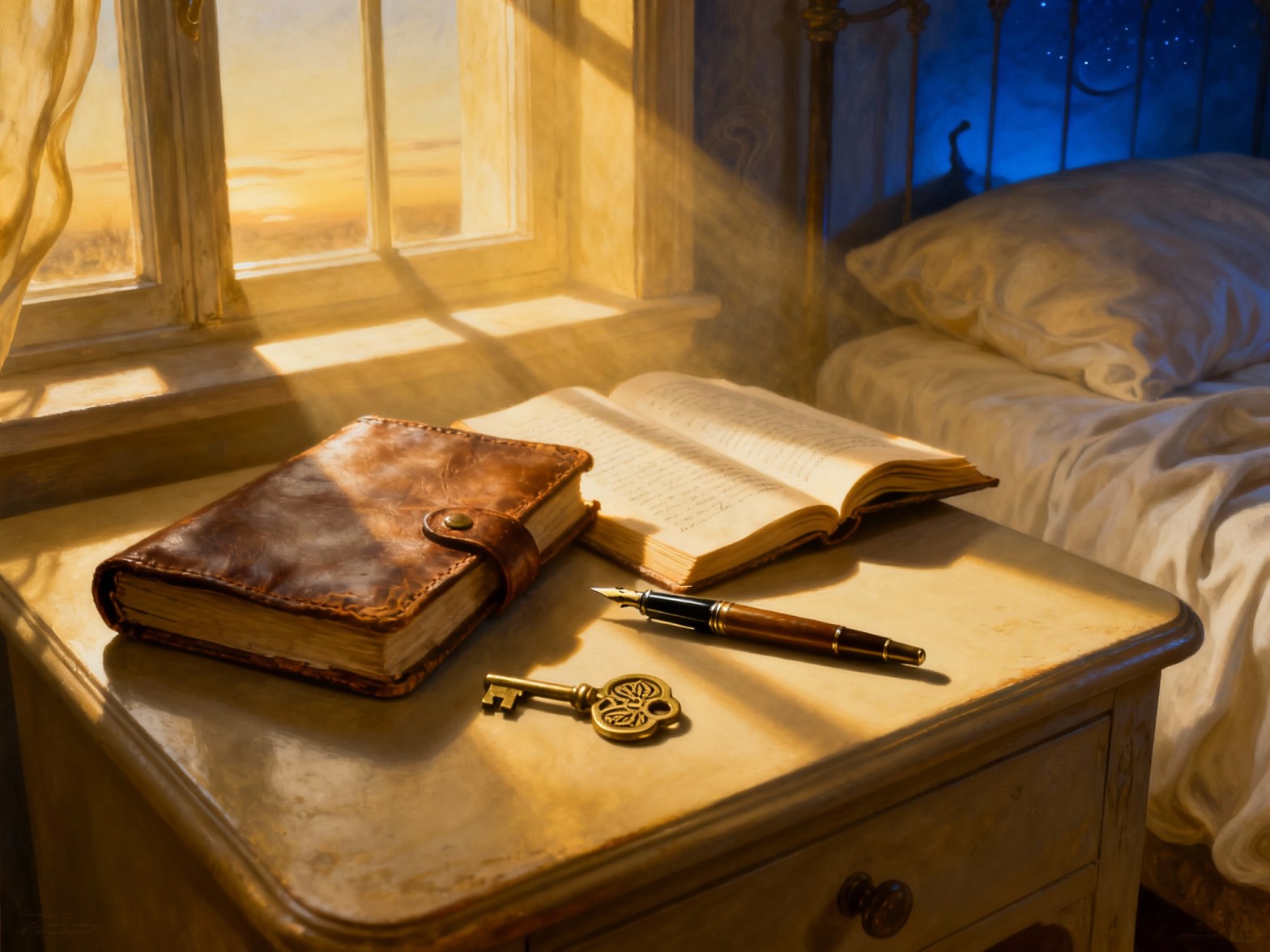
Salvador Dalí slept with a key in his hand, positioned over a metal plate. As he drifted off, the key would slip from his fingers and clang against the plate, jolting him awake just as dream images began to flood his mind. Mary Shelley dreamed the central scene of Frankenstein. Paul McCartney heard “Yesterday” in his sleep. These artists understood something fundamental: our dreams are portals to a vast creative reservoir that our waking mind barely touches.

The conscious mind, for all its cleverness, is just the tip of the iceberg. Below the surface lies the subconscious—a sprawling warehouse of memories, associations, and creative possibilities that consciousness can only access in fragments. During our waking hours, our rational mind acts as a gatekeeper, filtering and organizing, often blocking what it thinks are the strange and wonderful connections that fuel truly original ideas. But when we sleep, that gatekeeper steps aside.
Dreams are the subconscious finding its voice. With our conscious mind offline, the deeper layers of our psyche begin assembling thoughts in ways that defy logic but often hold surprising insight. Characters merge impossibly; time loops back on itself; everyday objects transform into symbols—all the bizarre imagery that makes dreams feel so surreal is actually our creative engine running without its usual constraints.
The tragedy is how quickly these visions dissolve. Dreams are phosphorescent, glowing brilliantly for mere moments before fading into nothing. You wake with a sense of having witnessed something profound, only to watch it evaporate like morning mist. Five minutes later, you can barely recall a single image. Ten minutes later, it’s gone completely.
This creates an impossible choice: sacrifice sleep to capture the dream, or sacrifice the dream to preserve sleep. Getting up to write a detailed account means disrupting rest, potentially making it harder to fall back asleep. But letting the dream slip away means losing whatever creative sparks it contained.
Well, the solution lies in compromise. Keep a notebook or phone beside your bed. When you wake from a vivid dream—whether in the middle of the night or first thing in the morning—don’t try to capture everything. Instead, jot down quick fragments: key images, emotions, the strangest details, essential plot points. Just a few words or phrases, whatever you can scrawl in the dark without fully waking yourself up.
These fragments act as anchors. Later, when you’re properly awake, those brief notes will help reconstruct the fuller dream. A single phrase like “me levitating ” or “falling but laughing” can unlock entire sequences that would have otherwise vanished. You’re essentially creating a signpost  that your waking mind can follow back into the territory of dreams.
Not every dream will yield creative gold, of course. But by making this practice habitual, you give yourself regular access to  your swirling subconscious. Over time, you’ll notice patterns, recurring symbols, and unexpected ideas that your conscious mind would never generate on its own. The reservoir is always there, waiting. You just need a way to dip into it without drowning in the process.

Note: I asked Chatbot to give me a few famous examples of who were inspired by their dreams for their works, hence the first paragraph.

Featured

On Stillness, Memory, and the Subconscious

As you may agree with me,  my blog entries so far have carried a sense of stillness, dream, and liminal awareness. While Discovering Stillness in Small Moments The Rest Between the Notes and Moonlit Threads, Human Ties are the clearest explorations of it, other posts also hover in that quiet, introspective register — even when their subjects differ.

When I write my reminiscences, it’s never just an act of remembering. It’s more like a quiet descent — a letting go — where I allow myself to drift as deeply as possible into the depths of my own subconscious. For a while, I suspend judgment. I loosen my grip on logic. I let the mind wander where it takes me, letting these remembrances run wild, unrestrained. 

Some of these thoughts surface in moments of stillness — those small, luminous pauses that I wrote about in Discovering Stillness in Small Moments. Others emerge from a more elusive source: the twilight realm between waking and dreaming. That half-lit territory has always fascinated me. In pieces like The Rest Between the Notes and Moonlit Threads, Human Ties, I began to sense how dreams and the subconscious can weave themselves into conscious reflection. The imagery, tone, and rhythm of those writings seem to come from somewhere deeper — as though they had been resting quietly inside me, waiting for the right moment to rise. 


Looking back, I realize that this process — this surrender to stillness and dream — is often where my writing begins. The subconscious seems to store fragments of experience: sensations, voices, faces, and fleeting impressions that never quite left me. When I stop trying to control them, they find their own way to the surface, sometimes as words, sometimes as images, sometimes as silence. 
Perhaps what I’m really exploring in all these pieces is how memory, stillness, and dream converge — how each moment of inner quiet allows the unseen parts of the mind to speak. In that sense, writing becomes less an act of mindful creation and more an act of listening. 


This is what I hope to explore next — the importance of dreams as a source of inspiration. For it’s often there, in the dim spaces of the subconscious, that the truest emotions and the most vivid images reside, waiting to be found.

Featured

Discovering Stillness in Small Moments — A Reflection on Life’s Impermanence

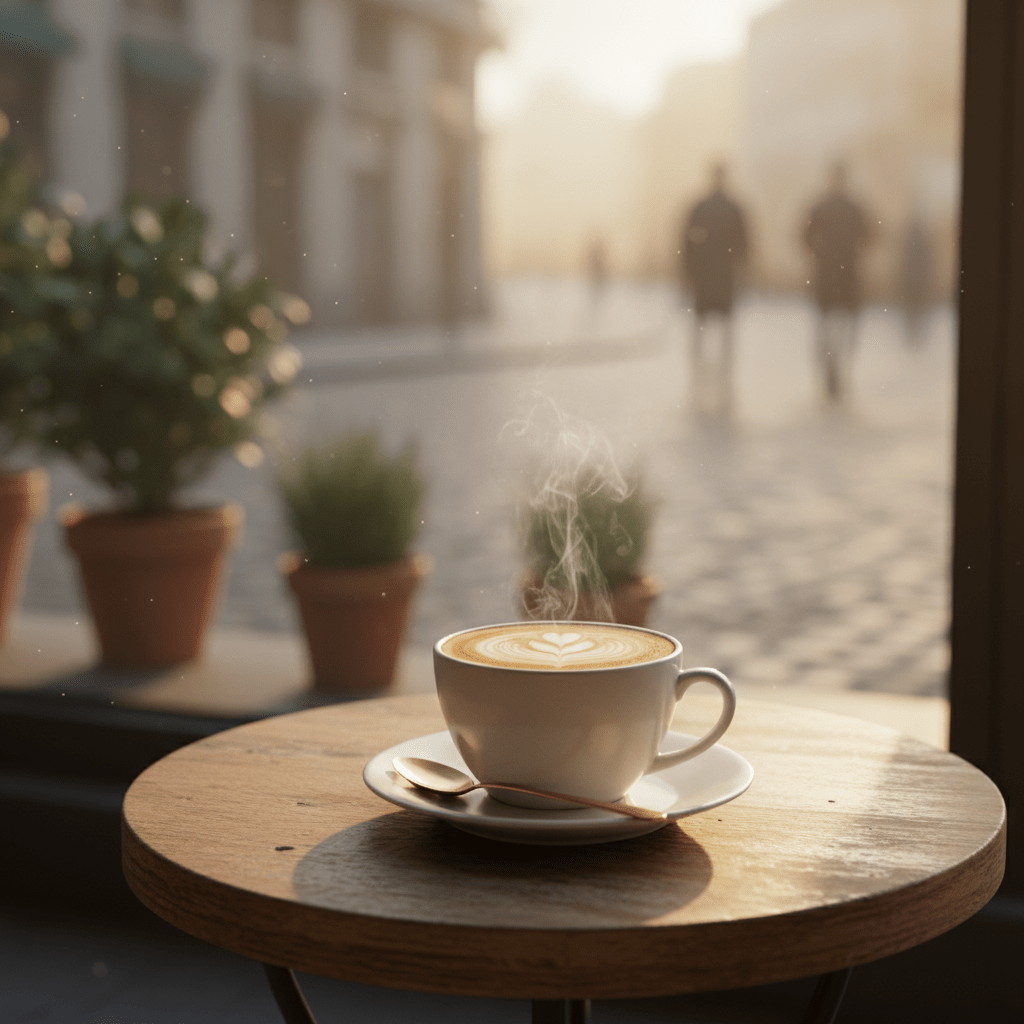
Recently, I’ve been spending  slow coffee mornings at Pret, sitting by the floor‑to‑ceiling glass window with a flat white or latte  in hand. Most of my time there slips away in writing and reading, punctuated now and then by moments of idle gazing—watching the world drift past the window.

Then there was another ordinary morning—so ordinary it almost escaped notice—the sunlight came streaming through the glass in slender, golden shafts. They fell across my table, catching the rising steam from my cup. Such a simple, fleeting thing—and yet something about it felt extraordinary, almost poetic.

That was it. No grand epiphany. No orchestral swell. Just a ribbon of light, and a sudden awareness that I had ‘seen’ it—truly seen it—not merely with my eyes but with some  part of the subconsciousness that rarely awakens. That tiny flicker of life was and vanished all in one breath. Just as all things do.

Maybe that’s the whole secret. We’re always searching for something real, something that endures. But perhaps it doesn’t take a story worthy of an ancient Greek tragedy  to remind us how fragile beauty really is. We wait for life to come in fanfare, when meaning often arrives softly: sunlight caressing a coffee cup; the conversations   of strangers at nearby tables  weaving their own stories; the stirring of our mind for some inspiration. Each moment appears, glints,  vanishes – the triptych of our being.


We don’t have to stand, like the man in the green overcoat in Casper David Friedric’s famous painting The Wanderer Above the Sea of Fog, gazing heroically at the horizon to have a brush with the sublime. Sometimes, it’s hidden inside the most mundane jiffies of our lives—tucked so gently into our days that we overlook them.

When I paused long enough to notice that light, something inside me paused too—or perhaps, stepped briefly into a state unbound by time. For that instant, I glimpsed what the Buddha called śūnyatā —emptiness not as absence, but as the infinite space from which all things arise and to which they return. It’s the Truth he awakened to beneath the Bodhi tree two and a half millennia ago.

Outside the window, the world then became a moving poem: blurred reflections, people passing through the sunlight, each heading into their own horizons.  None stayed long enough to be part of mine, and that, I realized, was a quiet comfort. Everything, like the light, moves on.

Maybe life is just that—a sequence of shimmering moments, each one vanishing even as we notice it. And yet, when we do notice, the ordinary becomes luminous. The mundane glows. Existence itself turns into poetry—fragile, radiant, ephemeral.

So now, each morning, I still sit by that window. The coffee tastes the same. The world still hurries past. The only difference is that sometimes, I look up from my screen and see how the light touches the steam, how time folds itself into an ordinary hour. And in that instant, I remember: 
The purpose of life is not to chase the permanent, but to experience the efflorescence —while it happens, in ribbons of gold, before it slips quietly into memory.

And then even memory thins to air.